
 Paul Klee
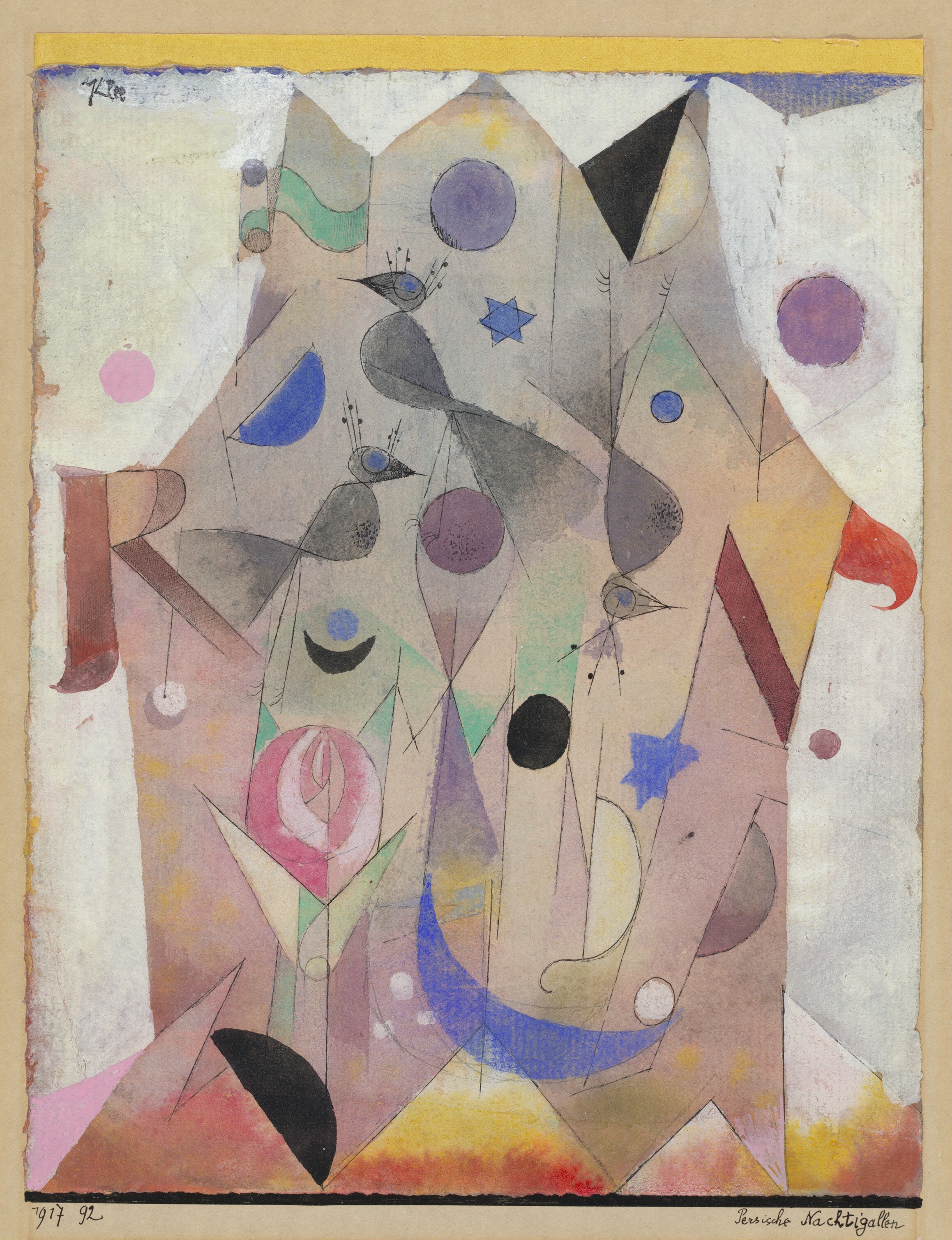
Literature often found its way into Paul Klee's art, and Persian Nightingales was probably inspired by the poetry of the 14th-century Persian poet Hafiz. Klee may have encountered Hafiz through Johann Wolfgang von Goethe's West-Eastern Divan, which introduced the Persian poet and his imagery to a German-speaking audience.
Hafiz's poetry celebrates love, wine, beauty, and the natural world, often moving effortlessly between earthly desire and spiritual longing. Among his recurring symbols are the nightingale and the rose: the nightingale represents the yearning lover, while the rose can embody perfect, even divine, beauty. Klee brings both motifs into his watercolor. A pink rose appears at the lower left, while three strange, sharply drawn nightingales dominate the center. One is even turned upside down, as though literally intoxicated by desire.
Klee also plays with language itself. The letters R and N, probably referring to Rose and Nachtigallen (German for “nightingales”), become part of the picture rather than simply labels. They float alongside the birds, stars, crescents, and other celestial forms, all sharing the same dreamlike space.
The work also reveals Klee's fascination with Persian miniature painting. Its jewel-like colors, delicate ornamentation, disregard for conventional perspective, and playful shifts in scale recall Persian manuscript illustrations. Even the composition, which seems to open through an arch or parted curtains, suggests the intimate format of a miniature. Klee had many opportunities to encounter Persian art in German museums, and he almost certainly saw the major 1910 exhibition of Islamic art in Munich, which presented thousands of objects and made a particularly strong impression on contemporary artists, including his friend Wassily Kandinsky.
P.S. Don't forget that your 2027 deserves more art. Our new calendars are here to make sure it gets it.
P.P.S. Dive into the magical underwater world of Paul Klee’s Fish Magic. See what strange creatures and symbols await beneath the surface.