
 Anna Ruysch
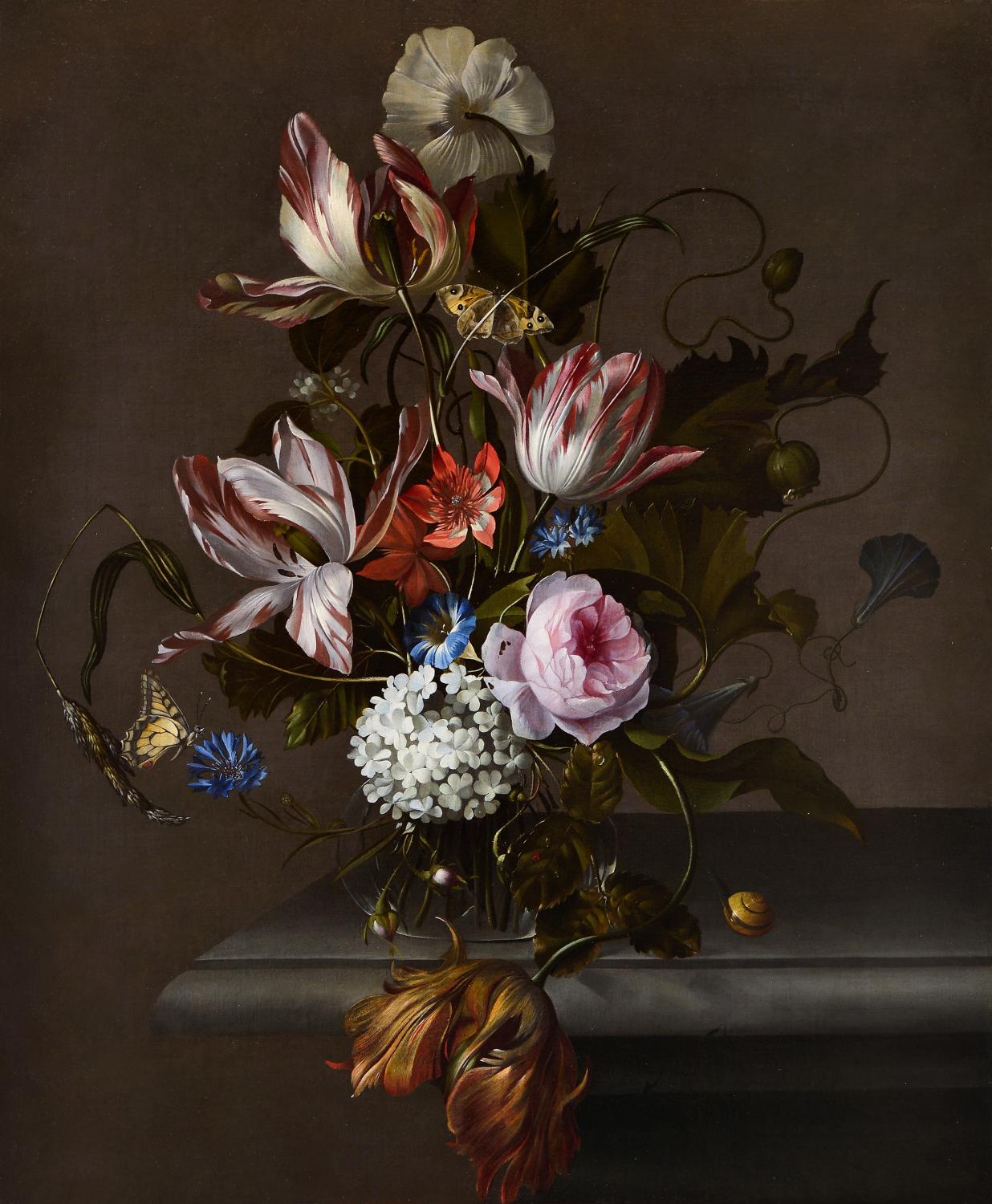
At first sight, Still Life of Flowers in a Glass Vase seems to capture a magnificent bouquet freshly gathered from a garden. In reality, Anna Ruysch carefully constructed an impossible arrangement from flowers that bloom at different times of the year. The bouquet is organized around a balanced diamond shape, but Ruysch prevents it from feeling static by introducing a sweeping S-curve through the stems and blossoms—a compositional device she learned from her teacher Willem van Aelst. Light enters dramatically from the upper left, catching individual petals and leaves while others disappear into shadow. This careful use of chiaroscuro creates an amazing depth and makes certain flowers seem to project toward us from the darkness.
Look closer, and the painting becomes even more alive. A swallowtail butterfly rests on a blue cornflower, a tiny ladybug crawls across a dew-covered rose leaf, another butterfly flies between two tulips, and a garden snail slowly approaches the glass vase—perhaps heading toward the already insect-nibbled roses. Ruysch depicts twelve different plants, three insects, and a snail with enough precision to identify them by species, reflecting both her artistic skill and the period's fascination with the natural sciences. For a 17th-century viewer, the fading flowers and damaged leaves could also evoke vanitas, reminding them that beauty and life are temporary, while the extraordinary variety of nature could simultaneously be understood as evidence of the magnificence of God's creation.
Anna Ruysch was a Dutch Golden Age painter specializing in elaborate flower still lifes. She was the younger sister of the much more famous Rachel Ruysch, and both women were daughters of the Amsterdam anatomist and botanist Frederik Ruysch. Growing up surrounded by his collections of botanical and anatomical specimens gave the sisters unusually close access to the study of nature. She painted luxurious flower arrangements against dark backgrounds, with dramatic lighting, curling stems, insects, and carefully observed botanical details. Anna’s career, however, is much less well documented than Rachel’s. She married the paint dealer Isaak Hellenbroek in 1688, and relatively few paintings can now be securely attributed to her.
P.S. Intrigued by the Ruysch family’s flower paintings? Discover five of Rachel Ruysch’s most beautiful still lifes.
P.P.S. Bring more flowers into your daily life with our Flowers in Art 50 Postcards Set. :)