
 W. & F. Langenheim
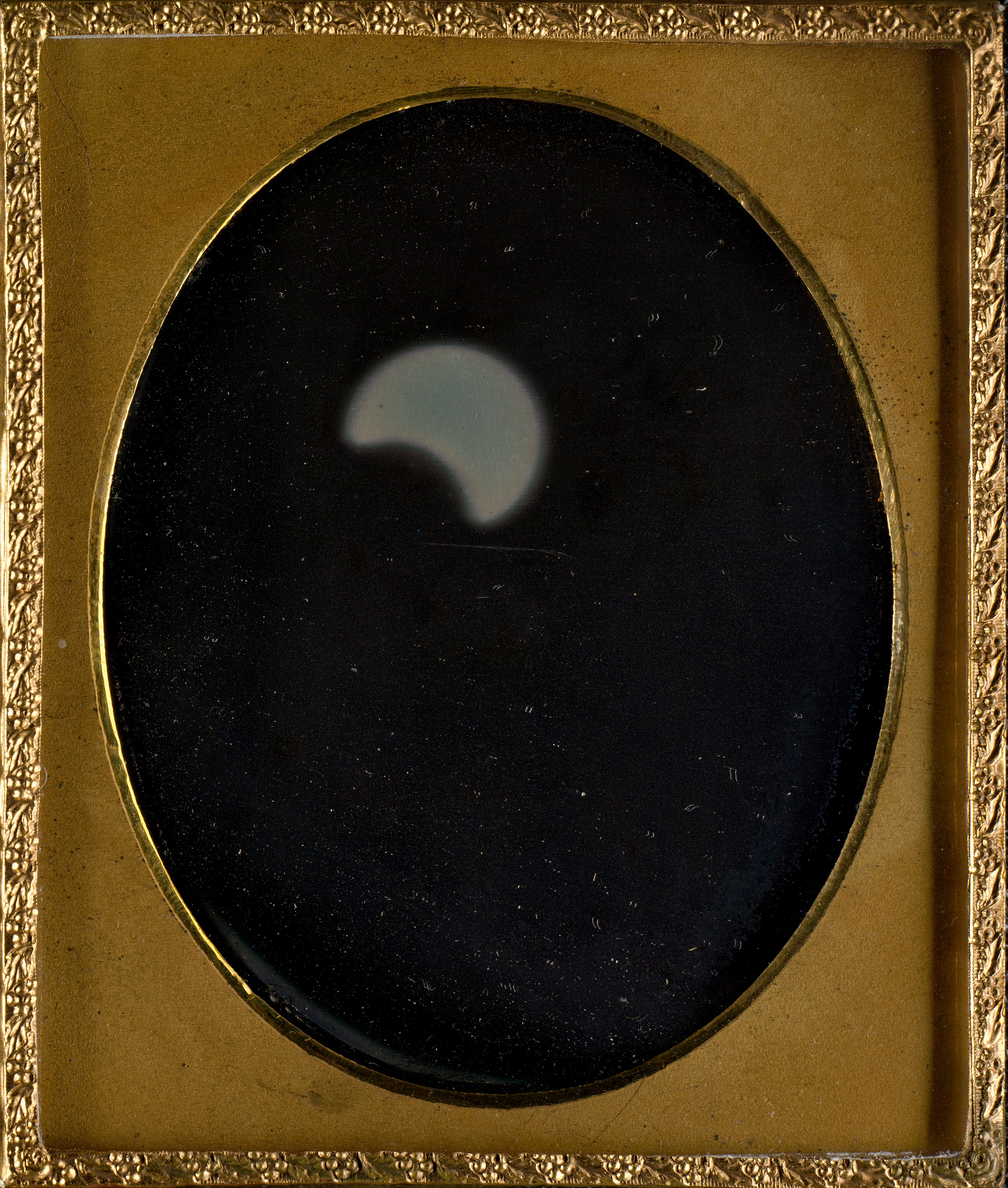
In 1841 or 1842, brothers William and Frederick Langenheim, former journalists, opened a daguerreotype studio in Philadelphia and soon became two of the city’s most celebrated photographers, known particularly for their technical experiments. On May 26, 1854, they turned their cameras toward the sky to record the first total solar eclipse visible in North America since photography's invention. They created a sequence of eight daguerreotypes, seven of which survive today. Curiously, the Moon appears to move across the Sun from left to right—the opposite of what actually happened. This is because daguerreotypes produce laterally reversed, mirror-like images.
Photographing an eclipse in the 1850s was an extraordinary technical challenge. The brothers used very small cameras and plates because smaller formats required less light—essential when the Moon was blocking almost all of the Sun. Three of the surviving photographs are exceptionally tiny. The missing eighth image may be the most intriguing of all: it was probably taken at the moment of totality, when so little light remained that the photographic plate recorded nothing. In other words, the photograph intended to capture the eclipse at its most spectacular moment may have been simply blank.
We chose this dark daguerreotype because ... THE BLACK WEEK PROMOS ARE COMING! That means, you can buy absolutely everything in our DailyArt Shop with a 25% discount! Calendars, custom prints, postcards, socks, notebooks and our digital courses are waiting. Enjoy your early access to our biggest sale of the year! :)